Dhaka rewards a selective plan. Its major public collections and civic buildings do not form one pedestrian district or offer the same access. Ahsan Manzil interprets elite life beside the Buriganga, Lalbagh Fort opens a window onto Mughal-era urban history, the Bangladesh National Museum ranges more broadly, and Parliament requires different preparation. Treating them as interchangeable photo stops produces a rushed day. This guide helps you choose a coherent theme, confirm access through the responsible institution and leave flexibility for a busy capital.
At a glance
Start here
- Choose two main interiors rather than collecting every landmark.
- Verify museum schedules and Parliament access on their own official pages.
- Keep Old Dhaka and Sher-e-Bangla Nagar as separate planning zones.
- Recheck current demonstrations, transport disruption and local instructions before setting out.
01
Choose a story before choosing buildings
The Bangladesh Tourism Board's Dhaka overview places Ahsan Manzil, Lalbagh Fort, the Bangladesh National Museum and the National Parliament among the capital's notable places. That shared city label can be misleading for planning: the sites represent different periods, institutions and parts of Dhaka. A useful day begins with a question. Are you most interested in the river-facing history of Old Dhaka, a national collection, or the architecture and public role of Parliament? Your answer should determine the anchor visit.
These are editorial pairings, not official itineraries. Keeping one clear thread also makes it easier to decide what to omit if traffic, closures or security conditions alter the day.
- Old Dhaka focus: river, palace museum and protected fort architecture.
- Civic focus: national collections, public institutions and modern architecture.
- Mixed focus: one Old Dhaka anchor plus one confirmed institution elsewhere.
02
Read Ahsan Manzil as a riverfront institution
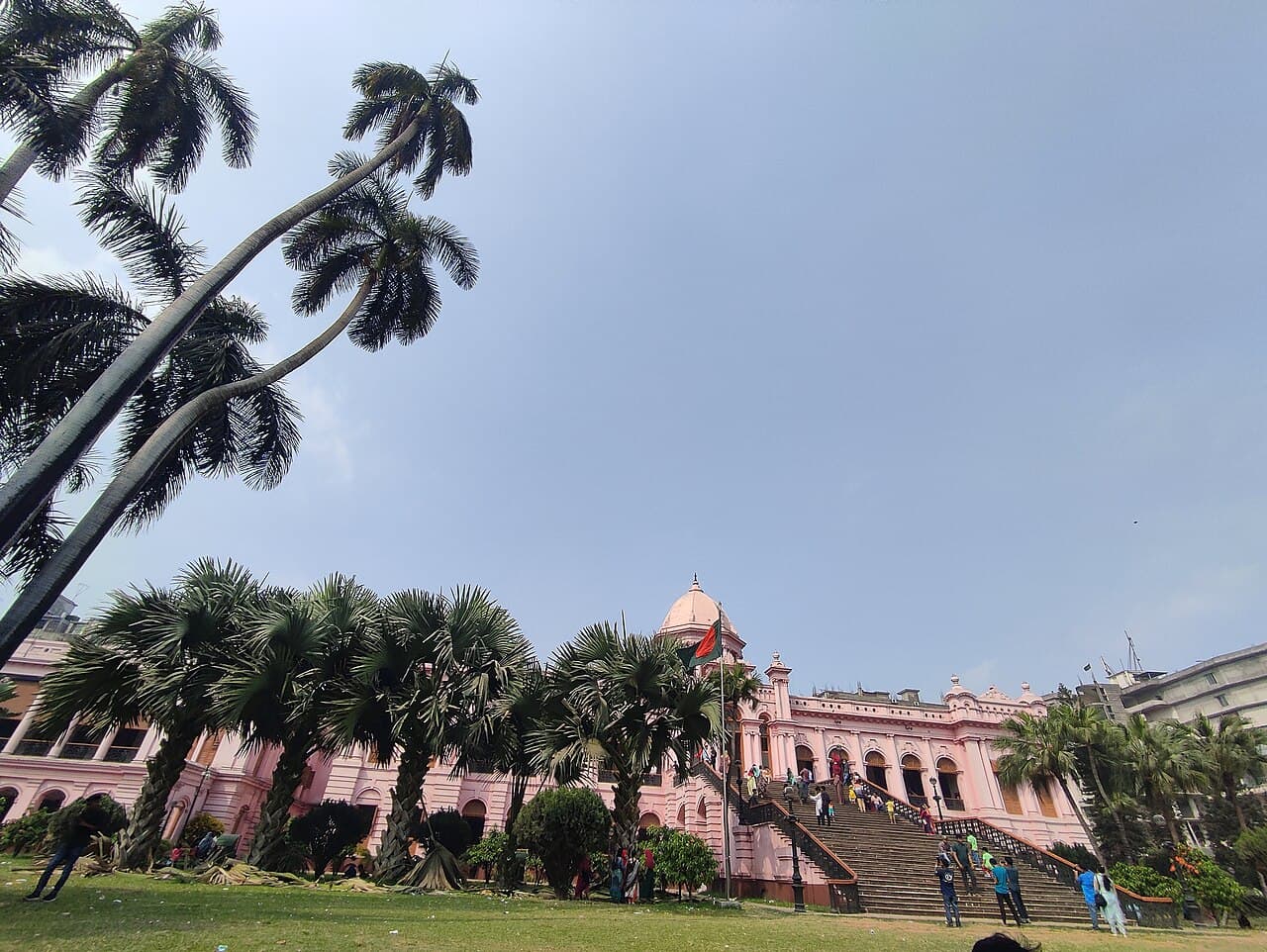
The Tourism Board identifies Ahsan Manzil as the former residential palace and seat of the Nawab of Dhaka on the bank of the Buriganga. It dates the main construction campaign to 1859–1872 and notes its present museum role. Those facts suggest a better way to visit: connect the building's formal rooms and exhibits to its river position, rather than treating the pink facade as an isolated image. The relationship between residence, influence and waterfront is central to understanding the place.
Before going, consult the Bangladesh National Museum's official schedule page because it publishes visiting information for its institutions, including Ahsan Manzil. Do not build a day around an old fee or opening-hours screenshot; institutional schedules and ticket rules can change. On site, separate what labels and exhibits establish from what a guide or social post merely repeats. A short note about one room, object or river view will usually preserve more meaning than dozens of near-identical photographs.
- Check the responsible museum authority's current notice before departure.
- Look for evidence connecting domestic space, administration and the river.
- Leave riverfront conditions and access decisions to current local instructions.
03
Use Lalbagh Fort for a protected-site contrast
Lalbagh Fort belongs in an Old Dhaka architecture day because the Department of Archaeology lists the fort and associated structures among protected monuments. That status matters more than trying to compress the complex into a single date or ruler. It tells visitors to approach the grounds as a conserved archaeological ensemble with boundaries and site rules, not as an open urban park. The Tourism Board's Dhaka page provides the city context, while the archaeology authority is the stronger source for protected status.
A productive comparison with Ahsan Manzil asks how the two compounds organize movement, enclosure and public presentation. Notice gates, axes, gardens, water elements and the distance between buildings without climbing, touching surfaces or crossing barriers for a better angle. Interpretation and access can evolve as conservation work proceeds, so read current signs on arrival. If an area is closed, use the changed route to study the larger composition instead of treating the closure as a reason to ignore site rules.
- Treat barriers as conservation information, not photography obstacles.
- Compare compounds and circulation instead of forcing a superficial checklist.
- Use current on-site interpretation for building names and access.
04
Make the National Museum an anchor, not a gap-filler
The Tourism Board includes the Bangladesh National Museum in its Dhaka destination overview, while the museum authority maintains the operational page for visiting schedules and admission information. That division is useful: one source helps establish why the institution belongs in a Dhaka plan; the other should control the practical decision. Because a national museum can cover far more than a traveler can absorb in one session, decide on two or three themes before entering and allow the gallery plan to refine them.
Themes might include archaeology, art, the natural environment or the formation of the nation, but the current galleries should determine what is actually available. Read introductory panels first, record exact object labels when a detail matters and resist turning a gallery into background for a prewritten story. Photography permissions, bag rules and accessible routes should be confirmed at the institution. If the museum posts a closure or altered schedule, replace it with a slower Old Dhaka pairing rather than inventing a substitute interior.
- Select a small number of collection themes before arriving.
- Let current gallery labels resolve names, dates and provenance.
- Verify photography, baggage and accessibility rules directly.
05
Treat Parliament as an advance-planning visit
Bangladesh Parliament publishes a dedicated visitor page with application routes for public, institutional and foreign visitors. It also lists prohibited items and notes that access is normally offered within stated public visiting periods. The key planning lesson is not to memorize the hours: Parliament is a working and security-sensitive institution, so an application, identity documents and current confirmation matter more than an old itinerary. Use the visitor page that applies to your visitor type and follow the latest instructions it provides.
If access is not confirmed, do not frame an exterior stop as a failed interior tour. The complex can still support a discussion of civic architecture from places where public presence and photography are allowed, but guards and posted restrictions set the boundary. Carry only what the current instructions permit, allow security procedures to take priority and avoid photographing people or controlled points without clear permission. A Parliament visit should stand on its own rather than being wedged between timed museum entries.
- Match the application form to local, foreign or institutional visitor status.
- Confirm permission before organizing transport around an interior visit.
- Follow current rules for devices, identification and photography.
06
Recheck conditions on the morning of the visit
Current foreign-government advice for Bangladesh warns that demonstrations can occur and may disrupt movement; the advice also tells travelers to avoid protests and large gatherings. These notices are nationality-specific, so they do not replace advice from your own government, insurance terms or instructions from Bangladeshi authorities. They do establish why a Dhaka cultural day needs a morning review rather than relying on a plan saved weeks earlier.
Check each institution's official notice, current local news and your government's travel advice. If a crowd, closure or security instruction affects the intended route, move away and use the optional-zone structure. Keep your accommodation informed of the broad plan, protect identity documents and retain a return option that does not depend on a single app or driver. This is contingency planning, not a claim that any named attraction is unsafe on a particular day.
- Avoid demonstrations and comply promptly with local security instructions.
- Use your own government's advice for decisions tied to nationality and insurance.
- Keep a simple indoor or local alternative rather than forcing the original route.
Useful answers
Reader questions
Can I visit Ahsan Manzil and Lalbagh Fort in one outing?
They make a coherent Old Dhaka pairing because one interprets a riverfront palace institution and the other is a protected archaeological complex. Whether both are open and reachable on your date must be checked with their responsible authorities and current local conditions. Treat one as the anchor so a closure or slow transfer does not turn the day into a race.
Sources: Bangladesh Tourism Board; Department of Archaeology, Bangladesh; Bangladesh National MuseumDo I need permission to enter Bangladesh Parliament?
Use Parliament's official visitor page. It provides different application routes and requirements for visitor types, including foreign visitors, and lists controlled items. Do not assume that arriving during a published visiting period guarantees entry. Obtain the required confirmation and follow the latest security instructions before organizing the rest of the day around an interior visit.
Sources: Bangladesh Parliament SecretariatWhere should I verify museum hours and ticket rules?
Check the Bangladesh National Museum's official visiting-schedule and admission page, then look for current notices from the institution you plan to enter. The museum authority covers the National Museum and associated institutions such as Ahsan Manzil. Avoid relying on prices or opening times copied into older blogs because these are mutable operational details.
Sources: Bangladesh National MuseumIs it sensible to visit during demonstrations?
No cultural stop is important enough to justify approaching a demonstration. Current foreign-government advice tells travelers to avoid protests and large gatherings. Check advice issued for your nationality, follow Bangladeshi authority instructions and change the route if conditions are unsettled. The warning is about current decision-making, not a prediction about a specific museum or district.
Sources: UK Foreign, Commonwealth & Development Office; U.S. Department of StateRead the evidence
Sources and further reading
These sources support the relevant sections above. Plans and comparisons are editorial suggestions. Check operators for current arrangements.
- Dhaka ↗Bangladesh Tourism Board · Accessed 14 September 2026
Official destination context and identification of Ahsan Manzil, Lalbagh Fort, Bangladesh National Museum and National Parliament as Dhaka attractions.
- Ahsan Manzil ↗Bangladesh Tourism Board · Accessed 14 September 2026
Official overview of Ahsan Manzil's Buriganga location, former Nawab residence function, construction period and present museum use.
- জাদুঘর পরিদর্শনের সময়সূচি ও প্রবেশমূল্য ↗Bangladesh National Museum · Accessed 14 September 2026
Current official location for museum visiting schedules and admission information; used as the verification route rather than freezing hours or fees in the article.
- Visit to Parliament ↗Bangladesh Parliament Secretariat · Accessed 14 September 2026
Official public-access process, visitor categories, application forms, contact route and prohibited-item rules for Parliament.
- প্রত্নস্হলের তালিকা ↗Department of Archaeology, Bangladesh · Accessed 14 September 2026
Official protected-monument listing used to establish Lalbagh Fort and associated Old Dhaka structures as conserved sites.
- Bangladesh travel advice ↗UK Foreign, Commonwealth & Development Office · Accessed 14 September 2026
Current advice on demonstrations, disruption and the need to follow local developments; nationality-specific and not used as a guarantee of safety.
- Bangladesh Travel Advisory ↗U.S. Department of State · Accessed 14 September 2026
Current U.S. risk level and advice to avoid demonstrations and large gatherings; used for contingency planning.