Sonargaon is more useful when approached as a set of connected heritage questions rather than one frozen old capital. Panam City's long street and surviving buildings show layers of trade, residence and colonial-era form. Nearby water features and bridges help explain how the settlement worked beyond its facades. The Bangladesh Folk Art and Crafts Foundation adds a different story: the public work of collecting, exhibiting, teaching and sustaining craft traditions. Combining them carefully reveals the difference between conserved architecture and living cultural practice. It also demands restraint, because vulnerable buildings, active institutions and local communities should not be treated as scenery without rules or consent.
At a glance
Start here
- Read Panam City as a street system, not a row of isolated facades.
- Use wells, canals, ponds and bridges to ask how the settlement functioned.
- Keep architectural history distinct from the craft foundation's living mission.
- Verify access and current conditions before leaving Dhaka.
01
Begin with the street, not the grandest facade
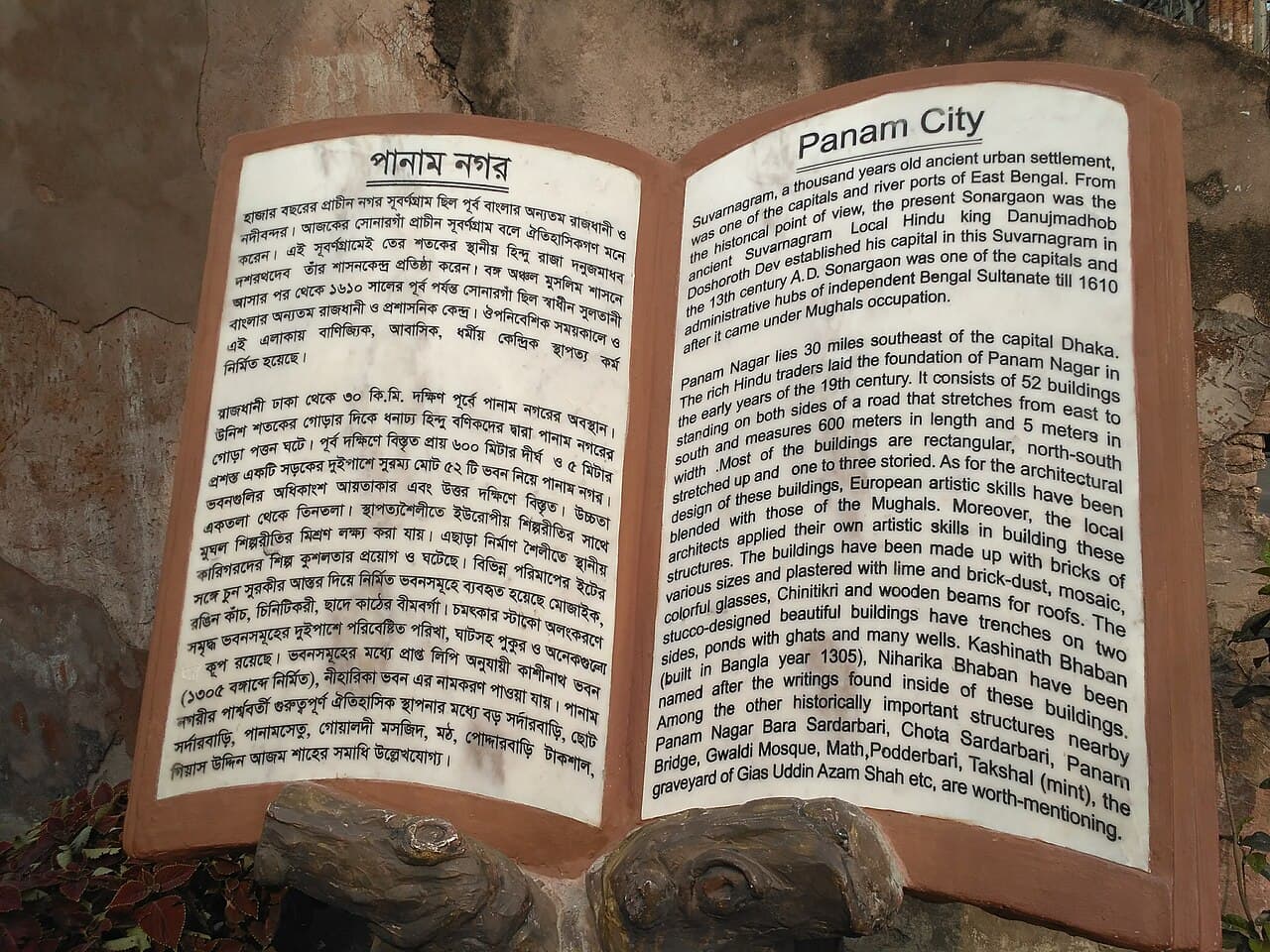
The Department of Archaeology describes Panam City as a settlement with 52 colonial-period buildings arranged along both sides of a road. That official description immediately changes the unit of attention. The subject is not one photogenic house but a repeated street edge: plot widths, doorways, upper floors, gaps, setbacks and the way one elevation answers another across the road. Start by looking along the street before selecting individual buildings.
The Tourism Board situates Panam within Sonargaon's longer Sultanate, Mughal and colonial histories. That does not mean every visible building belongs to every period. Use the broader chronology as context, then let current official labels establish what can be said about a specific structure. Avoid inventing merchants, household routines or dates from appearance alone. A careful reading says what the arrangement suggests and what the responsible authority actually identifies.
- Look down the street to understand rhythm and enclosure.
- Use official labels for individual dates and names.
- Separate visible evidence from an imagined domestic story.
02
Notice the architectural mix without oversimplifying it
The Department of Archaeology characterizes Panam's buildings as showing a mixture of European and Mughal elements. That is a starting point for observation, not permission to label every arch or column from a distance. Compare facade symmetry, arched openings, balconies, plaster work and rooflines, then consult on-site interpretation for a specific attribution. The value lies in seeing how imported and regional forms were assembled within the same commercial-residential street.
Weathering, repairs and loss are also part of the evidence. Do not touch decorative surfaces, lean on weak fabric or enter a restricted building to inspect a detail. A telephoto view from an allowed position is better than crossing a barrier. If conservation work changes access, record that as the site's current condition rather than treating the building as incomplete for visitors. Architectural reading should support conservation, not compete with it.
- Compare repeated elements before assigning a style label.
- Use distance or zoom instead of contact with fragile fabric.
- Treat repairs and closures as evidence of an evolving conserved site.
03
Follow the water systems beyond the facades
The archaeology authority notes wells, canals and ponds associated with Panam City and identifies nearby features such as Panam Bridge. These details keep the settlement from becoming a facade-only story. Water supplied daily needs, shaped movement and marked edges. From permitted paths, look for the relationship between the road, building backs, drainage, ponds and crossing points. Ask which features are historic, restored or modern rather than assuming every water body served the same role.
Water also makes conservation vulnerability visible. The Tourism Board notes flooding among threats recorded for Panam, alongside vandalism, unauthorized occupation and development pressure. Visitors cannot diagnose structural damage, but they can avoid adding pressure: remain on approved routes, do not climb and report immediate hazards to site staff. A strong photograph can show a building in relation to street and water without entering a fragile or private space.
- Look for connections among road, buildings, ponds and crossings.
- Ask staff which water features belong to which period.
- Do not enter unstable, closed or privately used areas.
04
Change the question at the craft foundation
The Bangladesh Folk Art and Crafts Foundation's official history states that the institution was established in 1975. Its published functions include preserving, researching, exhibiting and helping revive folk arts and crafts, as well as training activity. That mandate is different from Panam City's protected architectural fabric. At the foundation, ask how materials, techniques and knowledge are classified and sustained rather than treating craft objects as decorations detached from makers.
Current displays, workshops, sales arrangements and opening conditions can change, so verify them on the foundation's official site before travel and again on arrival. Do not describe an item as handmade, locally produced or connected to a named community unless the label or responsible seller supports that claim. If purchasing, ask who made it, what material was used and how payment benefits the producer. The question is more useful than bargaining from an invented idea of authenticity.
- Read institutional labels before assigning origin or technique.
- Ask evidence-based questions about maker, material and production.
- Confirm current displays and visitor operations directly.
05
Plan a respectful sequence, not a timed race
A logical editorial sequence is Panam City's street system followed by the craft foundation, or the reverse if current access requires it. Do not attach fixed journey times or promise that every component will be open. Confirm both institutions, establish the exact drop-off and return plan, and choose one as essential. Road conditions from Dhaka and site operations can change, so a flexible sequence is more credible than a tightly timed day trip.
Carry water and sun or rain protection appropriate to the day's forecast, but keep bags manageable around collections and fragile sites. Ask before photographing people, religious activity, staff or craft demonstrations. Do not direct a person to repeat work for an image without consent. If a guide is used, ask them to identify which statements come from official interpretation and which are local oral accounts; both can be valuable when labeled accurately.
- Confirm both components and choose one as the day's anchor.
- Keep the return arrangement flexible rather than promising a clock time.
- Ask consent before photographing people or work in progress.
06
Check current conditions before leaving Dhaka
The current Bangladesh travel advice published by the UK government warns that demonstrations can disrupt movement and advises avoiding protests and large gatherings. This advice is written for British nationals, so travelers should use their own government's guidance for nationality and insurance decisions. Its practical lesson is broader: a day trip by road should be reviewed on the morning of travel, not assumed from an older itinerary.
Check official site notices, local developments and the return route. If access is closed for conservation, security or an event, do not push past controls or substitute an unverified entrance. Keep the driver's or operator's identity and agreed pickup clear, and tell the accommodation the broad plan. These steps do not certify the journey as safe; they create opportunities to stop or revise it when current information differs from the original plan.
- Read current site notices and nationality-relevant travel advice.
- Avoid demonstrations and follow local authority directions.
- Do not bypass a closure in search of an alternative entrance.
Useful answers
Reader questions
Is Panam City one palace complex?
No. The Department of Archaeology describes a historic street with 52 colonial-period buildings on both sides. Read it as an urban ensemble of repeated plots, facades and service features, not one palace. Sonargaon's broader history provides context, but current official interpretation should identify individual buildings and their periods.
Sources: Department of Archaeology, Bangladesh; Bangladesh Tourism BoardWhat connects Panam City to the craft foundation?
They offer complementary but distinct heritage experiences. Panam centers on conserved architecture and settlement form. The Bangladesh Folk Art and Crafts Foundation has an official preservation, research, exhibition and training mandate for folk arts and crafts. Compare them, but do not claim that an object explains a building detail without supporting interpretation.
Sources: Department of Archaeology, Bangladesh; Bangladesh Folk Art and Crafts FoundationCan I enter every old building in Panam City?
Do not assume so. Conservation work, structural condition, private use or site controls can limit entry. Follow barriers and staff instructions on the day. The Tourism Board has documented threats including flooding, vandalism, occupation and development pressure, which is a reason to use permitted routes and avoid touching or climbing vulnerable fabric.
Sources: Bangladesh Tourism Board; Department of Archaeology, BangladeshHow should I verify opening information?
Use the Department of Archaeology and the Bangladesh Folk Art and Crafts Foundation's official sites, then look for current notices or contact details. Do not rely on old fares, opening hours or travel times reproduced elsewhere. Choose one anchor visit so a changed schedule does not encourage rushing or attempts to bypass access controls.
Sources: Department of Archaeology, Bangladesh; Bangladesh Folk Art and Crafts FoundationRead the evidence
Sources and further reading
These sources support the relevant sections above. Plans and comparisons are editorial suggestions. Check operators for current arrangements.
- পানাম সিটি, নারায়নগঞ্জ ↗Department of Archaeology, Bangladesh · Accessed 14 September 2026
Official description of Panam City's 52 colonial-period buildings, street arrangement, mixed architectural elements, water features and nearby heritage structures.
- Panam City ↗Bangladesh Tourism Board · Accessed 14 September 2026
Official Sonargaon historical context, Panam urban description and recorded conservation threats; mutable fares and journey times were excluded.
- হোম | বাংলাদেশ লোক ও কারুশিল্প ফাউন্ডেশন ↗Bangladesh Folk Art and Crafts Foundation · Accessed 14 September 2026
Current official institutional gateway used to verify visitor notices and public activities.
- ইতিহাস ও কার্যাবলি ↗Bangladesh Folk Art and Crafts Foundation · Accessed 14 September 2026
Official establishment history and functions in folk-art preservation, research, exhibition, revival and training.
- Bangladesh travel advice ↗UK Foreign, Commonwealth & Development Office · Accessed 14 September 2026
Current advice to avoid demonstrations and anticipate possible movement disruption; applied with a nationality-specific caveat.